1) What does this mean by the following statements?
Trust is not associative (non-symmetric):
In terms of buyers and sellers, the amount of trust each party has, isn't always the same. The sellers may have a high amount of trust which means the buyer will provide money for the good agreed upon. Even though the buyer may not have the same level of trust, as long as the money is paid, the seller will agree to sell the goods.
Trust is not transitive:
This means that just because the first customer trusts the seller, doesn't mean the second customer will. To a certain extent, this is true. While trust cannot be obtained directly onto the next customer, customers can rely on what other people say to determine whether they will trust the seller. But still, a seller needs to build up that trust. Not only by word of mouth, but have some sort of proof that the customer won't be dissatisfied with the transaction.
Trust is always between exactly 2 parties:
In some cases, this can be true. But it entirely depends on the number of parties involved. When the transaction is between a buyer and seller, this is generally true. But when suppliers, resellers, etc are involved - it can be said that trust can occur between more than two parties.
Trust will involve either direct trust or recommender trust:
Direct trust relates to a consumer basing their judgment of trust on their perspective to the transaction taking place. Recommender trust relates to a consumer basing their judgment on the views of others who have already had experience in the said transaction. With this said, it can be concluded that trust involves either direct or recommended trust.
2a) Have a look at the following websites. What are some of the elements that have been incorporated to increase your trust in the sites? If there are also some aspects which decrease your level of trust describe them as well.
http://www.eBay.com.au
Ebay has a security centre which gives tips on increasing the users' security. Having this feature enables the users to feel confident that everything is secure and enables a good piece of mind. There are constant logos and ebay-related images that solidify a genuine site.
A possible factor going against ebay is the few users who take advantage of other ebay users (Fraud).
http://www.anz.com.au
Without even having to move from the home page, it is obvious that this page is professinal and legitimate to ANZ. This enables users to know they are dealing with an actual bank website, and having certain images that correspond with advertisements they have on tv and in newspapers, allows users to gain a sense of comfort and trust. It has security alerts and proper copyright references.
http://www.thinkgeek.com
One thing that works for this site is that it looks like a lot of effort has gone into creating it which sends a message that if this site weren't trustworthy or legitimate, they wouldn't go to such measures. They had a customer service section which would aid in the confidence this site gives its users and having not been on this site before, if i was interested in the things they were selling, i would choose to use this site.
A possible factor working against this site i probably that it is unknown to many people, and people are always extra cautious when potentially buying off sites like these.
http://www.paypal.com
This site probably offers the most trustworthy features. When i clicked on the home page, it gave me an option to make my account more secure by enabling it to be controlled by mo own security system on my laptop. This straight away ensures security is their main priorety and they don't try to confuse you with over-excessive information.
2b) Find a web site yourself that you think looks untrustworthy.
http://www.ozlove.com.au/
One major untrustworthy segment online, is online dating. How do you know if the picture shown is what the person actually looks like. Worst case scenerio, it can be a place where potential rapists and murderers decide to choose their victims.
Tuesday, 21 May 2013

Saturday, 18 May 2013
TOPIC 9 - CHANNEL CONFLICT
Channel conflict can be defined as ‘any situation where two different marketing or distribution channels are competing for the same sale with the same brand’.

If you purchase something from a retail outlet is it then ok for you to get email promotions or is it SPAM?
Most retail stores now give the option to choose if you want to receive promotions through email or not. I personally will most likely always choose to not receive those promotions because of how regualar they are and the temptation they pose. I just recently paid for a trip to Fiji, and now need to save some spending money, however im seeing discounts and specials sent to me that tempt me to spend more money. As long as there is a choice, i don't think you can label it as spam.
Should you buy key words to protect your brand?
I think to become a massive brand that becomes a household name, you need to have a single word that signifies you and makes you stand out (Nike, Prada). Protecting your brand allows you to become unique and further promotes your image as a market leader rather than a market follower. McDonalds has been in regular legal dispute over other businesses who use any names under the McDonalds trademark, because they secured the name for their brand. In order to be fully in control of a word, it needs to be bought and therefore to protect your brand, you need to have paid your dues.
12 months on after the release of Windows 8, is it still an issue?
I think the primary reason Acer has lashed out at Microsoft is because they are threatened. Microsoft is a massive business with a huge customer-buying influence, and to bring out a platform that is essentially compatible with Microsoft's new software, is a competitor's worst nightmare. I can't speak for the rest of the population but a company who are leaders in software decide to bring out a platform to coincide with that release, i would be more inclined to buy that new product because of the company's knowledge and power of that market. To criticise Microsoft and say that 'It is not something you are good at' (ChinaTimes), is like telling an artist they are not creative. It doesn't make sense.
REFERENCES
ChinaTimes. (August 9, 2012). Acer CEO slams Microsoft's surface tablet. Retrieved May 18, 2013, from http://www.wantchinatimes.com/news-subclass-cnt.aspx?id=20120809000060&cid=1102
If you purchase something from a retail outlet is it then ok for you to get email promotions or is it SPAM?
Most retail stores now give the option to choose if you want to receive promotions through email or not. I personally will most likely always choose to not receive those promotions because of how regualar they are and the temptation they pose. I just recently paid for a trip to Fiji, and now need to save some spending money, however im seeing discounts and specials sent to me that tempt me to spend more money. As long as there is a choice, i don't think you can label it as spam.
Should you buy key words to protect your brand?
I think to become a massive brand that becomes a household name, you need to have a single word that signifies you and makes you stand out (Nike, Prada). Protecting your brand allows you to become unique and further promotes your image as a market leader rather than a market follower. McDonalds has been in regular legal dispute over other businesses who use any names under the McDonalds trademark, because they secured the name for their brand. In order to be fully in control of a word, it needs to be bought and therefore to protect your brand, you need to have paid your dues.
12 months on after the release of Windows 8, is it still an issue?
I think the primary reason Acer has lashed out at Microsoft is because they are threatened. Microsoft is a massive business with a huge customer-buying influence, and to bring out a platform that is essentially compatible with Microsoft's new software, is a competitor's worst nightmare. I can't speak for the rest of the population but a company who are leaders in software decide to bring out a platform to coincide with that release, i would be more inclined to buy that new product because of the company's knowledge and power of that market. To criticise Microsoft and say that 'It is not something you are good at' (ChinaTimes), is like telling an artist they are not creative. It doesn't make sense.
REFERENCES
ChinaTimes. (August 9, 2012). Acer CEO slams Microsoft's surface tablet. Retrieved May 18, 2013, from http://www.wantchinatimes.com/news-subclass-cnt.aspx?id=20120809000060&cid=1102
TOPIC 8 - ONLINE AUCTIONS
1) eBay is one of the only major Internet "pure plays" to consistently make a profit from its inception. What is eBay's business model? Why has it been so successful?
eBay's business model is primarily formed around being an auction broker. This means that auctions are conducted for the seller, given that they prescribe a fee. Buyers can then make offers on the seller's products until the time lapse comes to a close. The buyer with the highest bid is then able to purchase that product, just like at a physical auction.

The reason ebay has been so successful, is beacuse it allows an endless range of goods to be sold and bought, that differ in terms of condition, location and price. There is also the theory that many of the specialty items can't be found anywhere else beacuse they are not excessively in demand. It has strong productive features like easy navigation, clear layout and a secure payment method (paypal).
2) Other major web sites, like Amazon.com and Yahoo!, have entered the auction marketplace with far less success than eBay. How has eBay been able to maintain its dominant position?
In relation to Amazon, ebay is able to maintain its dominant position by bringing buyers and sellers together. Amazon holds the items being sold on its site which enables the transaction to be completely processed by the buyer and seller, meaning it doesn't have to worry about possilbe holding fees and shipment/delivery costs. Another thing that ebay has working for them is their use and promotion of paypal. Ebay has seen paypal become a massive money making machine, $US1.4 billion last quarter, a 26 per cent jump from the same quarter a year ago (Perlroth).
3) What method does eBay use to reduce the potential for fraud among traders on its site? What kinds of fraud, if any, are eBay users most susceptible?
The only way ebay is able to monitor and act upon fraud is by conducting feedback surveys for its customers that allows ebay to be aware of users that are conducting fake acts and sales. They also employ people specifically to deal with fraud and who are paid to seek out people who are selling false items or who are misleading.
Types of fraud that can occur on ebay include:
- paying for an item, and not receiving the item.
- sending your item away and not receiving payment. People from third world countries often try to buy items on ebay by telling the seller that they have already payed for the item, that it will just take a few days to come through, the seller believes them and sends the item away, and the buyer receives the item for free.
- paying for an item, and not receiving what you were promised.
4) eBay makes every effort to conceptualize its users as a community (as opposed to, say "customers" or "clients"). What is the purpose of this conceptual twist and does eBay gain something by doing it?
The purpose of labellising their customers and clients as a community, is because it gives them the idea that they are apart of the company and that they are a part of ebay's success. The biggest gain ebay can make by this formation, is becoming a reputable brand name that envisages its clients and customers needs and wants as their main priorety. Trust can be a big issue with online auctions so having clients and customers that value the company's input and process, allows ebay to be seen as a sort of town mayor.
5) eBay has long been a marketplace for used goods and collectibles. Today, it is increasingly a place where major businesses come to auction their wares. Why would a brand name vendor set-up shop on eBay?
The price of setting up your own website can be very costly which is why more and more businesses are using ebay as a source to sell their products. Ebay already has millions of customers, which gives businesses maximum opportunity for potential customers to purchase their products. You are able to access a wider target market; not just the business' primary target market. Ebay enables other businesses to use its resources without having to pay out of the bucket for them. It also allows the business to communicate directly to the consumer, whereas with their own site, there would be a barrier due to not having an intermediary such as ebay.
REFERENCES
Perlroth, N. (July 20, 2012). ebay powers on to make itself a dominant force. Retrieved May 18, 2013, from http://www.smh.com.au/business/ebay-powers-on-to-make-itself-a-dominant-force-20120719-22d12.html
eBay's business model is primarily formed around being an auction broker. This means that auctions are conducted for the seller, given that they prescribe a fee. Buyers can then make offers on the seller's products until the time lapse comes to a close. The buyer with the highest bid is then able to purchase that product, just like at a physical auction.
The reason ebay has been so successful, is beacuse it allows an endless range of goods to be sold and bought, that differ in terms of condition, location and price. There is also the theory that many of the specialty items can't be found anywhere else beacuse they are not excessively in demand. It has strong productive features like easy navigation, clear layout and a secure payment method (paypal).
2) Other major web sites, like Amazon.com and Yahoo!, have entered the auction marketplace with far less success than eBay. How has eBay been able to maintain its dominant position?
In relation to Amazon, ebay is able to maintain its dominant position by bringing buyers and sellers together. Amazon holds the items being sold on its site which enables the transaction to be completely processed by the buyer and seller, meaning it doesn't have to worry about possilbe holding fees and shipment/delivery costs. Another thing that ebay has working for them is their use and promotion of paypal. Ebay has seen paypal become a massive money making machine, $US1.4 billion last quarter, a 26 per cent jump from the same quarter a year ago (Perlroth).
3) What method does eBay use to reduce the potential for fraud among traders on its site? What kinds of fraud, if any, are eBay users most susceptible?
The only way ebay is able to monitor and act upon fraud is by conducting feedback surveys for its customers that allows ebay to be aware of users that are conducting fake acts and sales. They also employ people specifically to deal with fraud and who are paid to seek out people who are selling false items or who are misleading.
Types of fraud that can occur on ebay include:
- paying for an item, and not receiving the item.
- sending your item away and not receiving payment. People from third world countries often try to buy items on ebay by telling the seller that they have already payed for the item, that it will just take a few days to come through, the seller believes them and sends the item away, and the buyer receives the item for free.
- paying for an item, and not receiving what you were promised.
4) eBay makes every effort to conceptualize its users as a community (as opposed to, say "customers" or "clients"). What is the purpose of this conceptual twist and does eBay gain something by doing it?
The purpose of labellising their customers and clients as a community, is because it gives them the idea that they are apart of the company and that they are a part of ebay's success. The biggest gain ebay can make by this formation, is becoming a reputable brand name that envisages its clients and customers needs and wants as their main priorety. Trust can be a big issue with online auctions so having clients and customers that value the company's input and process, allows ebay to be seen as a sort of town mayor.
5) eBay has long been a marketplace for used goods and collectibles. Today, it is increasingly a place where major businesses come to auction their wares. Why would a brand name vendor set-up shop on eBay?
The price of setting up your own website can be very costly which is why more and more businesses are using ebay as a source to sell their products. Ebay already has millions of customers, which gives businesses maximum opportunity for potential customers to purchase their products. You are able to access a wider target market; not just the business' primary target market. Ebay enables other businesses to use its resources without having to pay out of the bucket for them. It also allows the business to communicate directly to the consumer, whereas with their own site, there would be a barrier due to not having an intermediary such as ebay.
REFERENCES
Perlroth, N. (July 20, 2012). ebay powers on to make itself a dominant force. Retrieved May 18, 2013, from http://www.smh.com.au/business/ebay-powers-on-to-make-itself-a-dominant-force-20120719-22d12.html
Friday, 17 May 2013
TOPIC 7 - AUTOMATA
1) Check this link to my ‘intelligent’ cybertwin which I also mentioned in the Powerpoint. You may like to create your own cybertwin as well. The more you 'train' your twin, the better the responses will be. While it is just a fun exercise, Think of the opportunities. Imagine if we had a cybertwin that could answer your questions about the course. Or perhaps a shopping assistant?
The idea of a robotic reactor being able to answer your questions, especially as a source of knowledege for a course, is a productive way of enabling students to have 24 hour access to guidance. Some problems however with something as sophistocated with this innovation is the ability to get detailed responses to questions, where with human interaction, you could. I think as assistance factor it could be used with success, however to use it as a major teaching source isn't appropriate.
2) Write one paragraph describing the Turing test and another paragraph describing an argument against the Turing Test, known as the about the Chinese room.
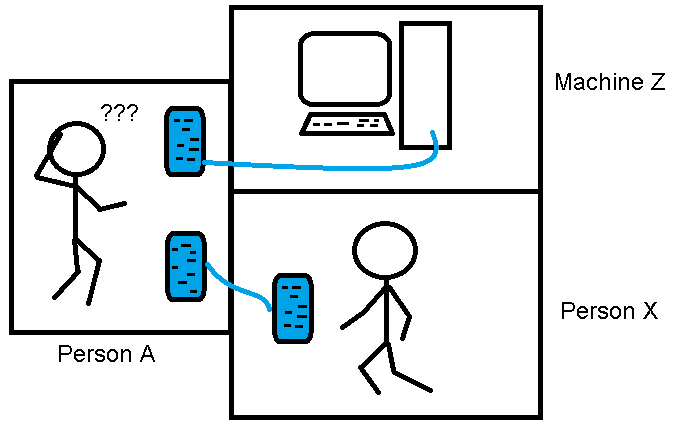
The Turing Test is a theoretical test for determining whether or not a machine intelligence can converse like a human. The test is named after WWII-era computer genius Alan Turing, who made it up. The Turing Test is an anthropocentric test, which means that it doesn't test for intelligence in general, but merely the ability to converse like a human being. The early implication was that the test measured objective intelligence. However, there could potentially be an Artificial Intelligence that merely doesn't speak human languages or understand human conversation (wiseGEEK).
The Chinese Room argument was devised by John Searle, and is an argument against the possibility of true artificial intelligence. The argument centers on a thought experiment in which someone who knows only English sits alone in a room following English instructions to construct strings of Chinese characters; to the point that people outside the room believe the person inside can speak Chinese. The argument is intended to show that while suitably programmed computers may appear to converse in natural language, they are not capable of understanding language, even in principle (Standford encyclopedia of philosophy).
3) Can virtual agents succeed in delivering high-quality customer service over the Web? Think of examples which support or disprove the question or just offer an opinion based on your personal experience.
I think it depends on what knowledge the virtual agent contains and what the nature of the question involves. For example if these virtual agents were to be introduced to give medical advice as a 24/7 medical assistance program, the quality of the responses couldn't be trusted upon enough; this is beacuse it deals with the properties of ones life. However if you look at introducing it into an organisation like Telstra, it would save customers waiting on hold for hours and could boost Telstra's overall reputation. The knowlege needed wouldn't be as thorough as with the medical outlook, and it would make sense that a computerised robot would be answering questions about technological problems; mainly because it uses similar systems.
REFERENCES
Standford Encyclopedia of Philosophy. (September 22, 2009). The Chinese room argument. Retrieved May 18, 2013, from http://plato.stanford.edu/entries/chinese-room/
wiseGEEK. (2013). What is the turning test?. Retrieved May 18, 2013, from http://www.wisegeek.com/what-is-the-turing-test.htm
The idea of a robotic reactor being able to answer your questions, especially as a source of knowledege for a course, is a productive way of enabling students to have 24 hour access to guidance. Some problems however with something as sophistocated with this innovation is the ability to get detailed responses to questions, where with human interaction, you could. I think as assistance factor it could be used with success, however to use it as a major teaching source isn't appropriate.
2) Write one paragraph describing the Turing test and another paragraph describing an argument against the Turing Test, known as the about the Chinese room.
The Turing Test is a theoretical test for determining whether or not a machine intelligence can converse like a human. The test is named after WWII-era computer genius Alan Turing, who made it up. The Turing Test is an anthropocentric test, which means that it doesn't test for intelligence in general, but merely the ability to converse like a human being. The early implication was that the test measured objective intelligence. However, there could potentially be an Artificial Intelligence that merely doesn't speak human languages or understand human conversation (wiseGEEK).
The Chinese Room argument was devised by John Searle, and is an argument against the possibility of true artificial intelligence. The argument centers on a thought experiment in which someone who knows only English sits alone in a room following English instructions to construct strings of Chinese characters; to the point that people outside the room believe the person inside can speak Chinese. The argument is intended to show that while suitably programmed computers may appear to converse in natural language, they are not capable of understanding language, even in principle (Standford encyclopedia of philosophy).
3) Can virtual agents succeed in delivering high-quality customer service over the Web? Think of examples which support or disprove the question or just offer an opinion based on your personal experience.
I think it depends on what knowledge the virtual agent contains and what the nature of the question involves. For example if these virtual agents were to be introduced to give medical advice as a 24/7 medical assistance program, the quality of the responses couldn't be trusted upon enough; this is beacuse it deals with the properties of ones life. However if you look at introducing it into an organisation like Telstra, it would save customers waiting on hold for hours and could boost Telstra's overall reputation. The knowlege needed wouldn't be as thorough as with the medical outlook, and it would make sense that a computerised robot would be answering questions about technological problems; mainly because it uses similar systems.
REFERENCES
Standford Encyclopedia of Philosophy. (September 22, 2009). The Chinese room argument. Retrieved May 18, 2013, from http://plato.stanford.edu/entries/chinese-room/
wiseGEEK. (2013). What is the turning test?. Retrieved May 18, 2013, from http://www.wisegeek.com/what-is-the-turing-test.htm
Subscribe to:
Comments (Atom)