The idea of a robotic reactor being able to answer your questions, especially as a source of knowledege for a course, is a productive way of enabling students to have 24 hour access to guidance. Some problems however with something as sophistocated with this innovation is the ability to get detailed responses to questions, where with human interaction, you could. I think as assistance factor it could be used with success, however to use it as a major teaching source isn't appropriate.
2) Write one paragraph describing the Turing test and another paragraph describing an argument against the Turing Test, known as the about the Chinese room.
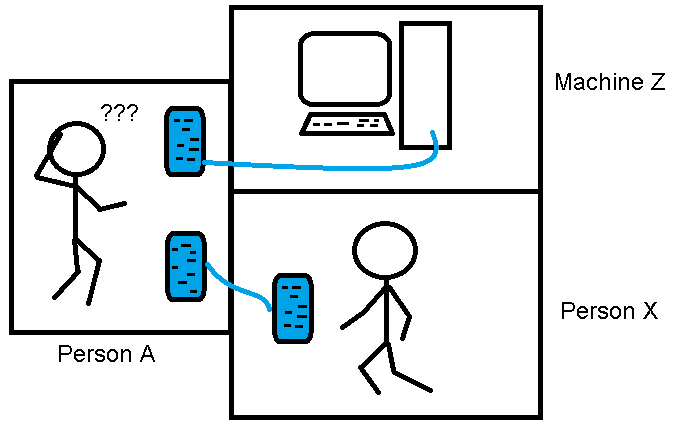
The Turing Test is a theoretical test for determining whether or not a machine intelligence can converse like a human. The test is named after WWII-era computer genius Alan Turing, who made it up. The Turing Test is an anthropocentric test, which means that it doesn't test for intelligence in general, but merely the ability to converse like a human being. The early implication was that the test measured objective intelligence. However, there could potentially be an Artificial Intelligence that merely doesn't speak human languages or understand human conversation (wiseGEEK).
The Chinese Room argument was devised by John Searle, and is an argument against the possibility of true artificial intelligence. The argument centers on a thought experiment in which someone who knows only English sits alone in a room following English instructions to construct strings of Chinese characters; to the point that people outside the room believe the person inside can speak Chinese. The argument is intended to show that while suitably programmed computers may appear to converse in natural language, they are not capable of understanding language, even in principle (Standford encyclopedia of philosophy).
3) Can virtual agents succeed in delivering high-quality customer service over the Web? Think of examples which support or disprove the question or just offer an opinion based on your personal experience.
I think it depends on what knowledge the virtual agent contains and what the nature of the question involves. For example if these virtual agents were to be introduced to give medical advice as a 24/7 medical assistance program, the quality of the responses couldn't be trusted upon enough; this is beacuse it deals with the properties of ones life. However if you look at introducing it into an organisation like Telstra, it would save customers waiting on hold for hours and could boost Telstra's overall reputation. The knowlege needed wouldn't be as thorough as with the medical outlook, and it would make sense that a computerised robot would be answering questions about technological problems; mainly because it uses similar systems.
REFERENCES
Standford Encyclopedia of Philosophy. (September 22, 2009). The Chinese room argument. Retrieved May 18, 2013, from http://plato.stanford.edu/entries/chinese-room/
wiseGEEK. (2013). What is the turning test?. Retrieved May 18, 2013, from http://www.wisegeek.com/what-is-the-turing-test.htm

No comments:
Post a Comment